The Bakerloo Line is one of London Underground’s most iconic routes, instantly recognizable by its distinctive brown color on the Tube map. Running from Harrow & Wealdstone in northwest London to Elephant & Castle in the south, this historic line serves 25 stations across some of London’s most vibrant neighborhoods.
In this comprehensive guide, we cover everything you need to know about the Bakerloo Line, including:
✔ Detailed Bakerloo Line map and route
✔ Complete list of Bakerloo Line stations
✔ Bakerloo Line timetable and operating hours
✔ Fascinating historical facts
✔ Essential travel tips
Whether you’re a daily commuter or planning your first London visit, this guide will help you master the Bakerloo Line Map.
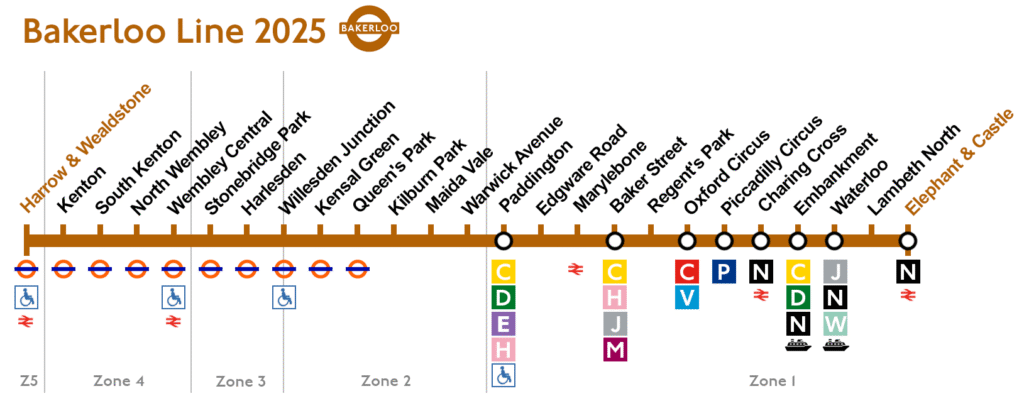
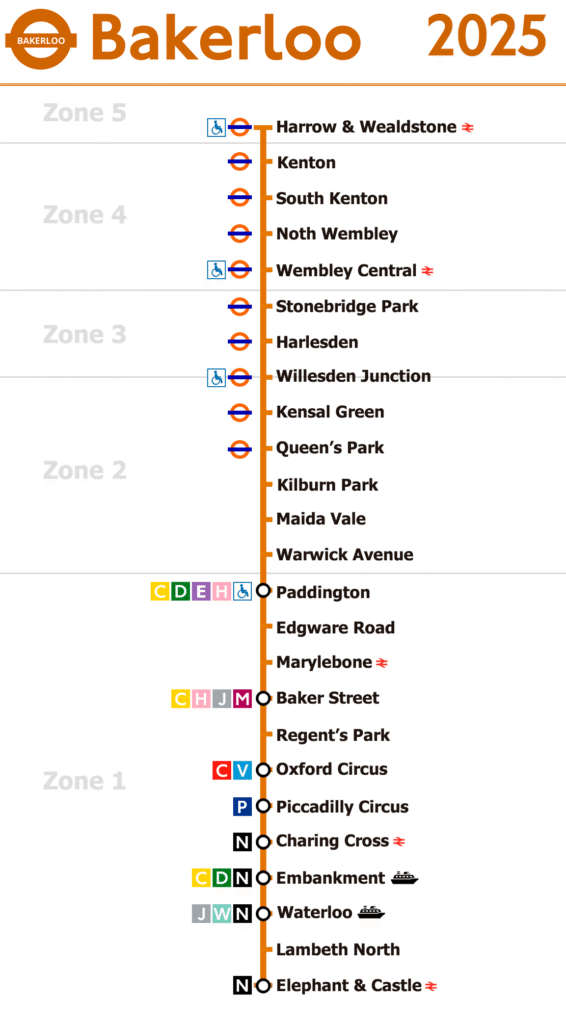
Bakerloo line map


1. Overview of the Bakerloo Line map (London Underground)
The Bakerloo Line isn’t just another Tube route—it’s a living piece of London’s transport history, blending Edwardian charm with modern commuting needs. Here’s why this brown line stands out:
🚇 Historical Significance
- Opened in 1906 as London’s first deep-level electric railway
- Original Name: “Baker Street & Waterloo Railway” (hence “Baker-loo”)
- Engineering Marvel: Used escalators at Piccadilly Circus in 1906 (a world first)
📍 Route Essentials bakerloo map
| Feature | Details |
| Termini | Harrow & Wealdstone (North) ↔ Elephant & Castle (South) |
| Length | 23.2 km (14.5 miles) |
| Stations | 25 (All step-free at platform level) |
| Daily Ridership | 400,000+ passengers (Pre-pandemic) |
| Operated By | Transport for London (TfL) |
| Line Color | Brown (Chosen in 1930s to represent earth/dug tunnels) |
🔗 Key Connections bakerloo map
The Bakerloo’s strength lies in its strategic interchanges:
✔ At Paddington: Elizabeth Line (Heathrow) & National Rail
✔ At Waterloo: Jubilee/Northern Lines + Eurostar
✔ At London Bridge: Northern Line + Thameslink
✔ At Willesden Junction: Overground to Stratford
🌟 Unique Stations: bakerloo map
- Baker Street: Original 1906 tiling and Sherlock Holmes silhouettes
- Maida Vale: London’s first female-staffed station (1915)
🚆 Modern Operations bakerloo map
- Trains: 1972 Stock (oldest on the network, due for replacement in 2030s)
- Frequency:
- Central Section: Every 2-3 mins peak
- Outer Sections: Every 5-8 mins
- Speed: Average 30 km/h (slower due to tight curves)
🌍 Why It Matters Today
- Commuter Essential: Direct link between NW London suburbs and West End
- Theatre Goers’ Secret: Serves:
- Piccadilly Circus (5 mins to Shaftesbury Ave theatres)
- Embankment (short walk to Strand venues)
- Future-Proofed: Part of Crossrail 2 proposals
💡 Did You Know?
The Bakerloo Line once extended to Watford Junction (until 1982)—some platforms are still visible!
Next time you ride: Look for:
- Original Edwardian tiles at Lambeth North
- WWII blast walls between Charing Cross and Embankment
2. Bakerloo Line Map & Route: The Ultimate Visual Guide
🚇 Anatomy of the Route
The Bakerloo Line’s 25 stations form three distinct operational segments:
- Northern Suburban Stretch (Above Ground)
- Harrow & Wealdstone to Queen’s Park
- Runs parallel to London Overground (shared tracks)
- Only section where trains exceed 50 mph
- Central Core (Deep-Level Tube)
- Queen’s Park to Elephant & Castle
- Features London’s sharpest curve between Paddington and Warwick Avenue
- Deepest point: 22m below at Oxford Circus
- Southern Terminus
- Elephant & Castle designed for potential extension to Camberwell (never built)
🔀 Interchange Intelligence
Advanced connection strategies at major stations:
Paddington:
- For Elizabeth Line: Use Praed Street exit (2-min walk to new station)
- Avoid: Transferring during 8:15-8:45 AM peak crush
Oxford Circus:
- Secret shortcut: Diagonal crossing between Bakerloo/Victoria lines saves 3 mins
- Worst congestion: Southbound platform 4-5 PM
Waterloo:
- Eurostar transfer: Follow brown line markers to avoid Jubilee Line scrum
- Hidden exit: Exit 5 leads directly to South Bank attractions
⏱️ Timed Transfers
Calculate these perfect connections:
- Harrow & Wealdstone → Euston: 22 mins (faster than Overground)
- Paddington → Oxford Circus: 7 mins (vs 12 mins via Elizabeth+Central)
- Waterloo → Charing Cross: 90 secs (walking takes 5+ mins)
🚧 Infrastructure Insights
What makes this line unique:
- Tunneling Technique: Used “cut-and-cover” north of Queen’s Park
- Power Systems: Still uses original 630V DC power supply in central section
- Signal Upgrades: Being modernized for 27 trains/hour capacity
🎨 Design Legacy
Spot these heritage features:
- Baker Street: Original 1906 platform tiles with BS&WR monograms
- Maida Vale: London’s first station designed for female staff (1915)
- Kilburn Park: Unique barrel-vaulted ceiling (inspired by NY Subway)
🚦 Service Patterns
Understanding train destinations:
- AM Peak: 1:3 trains terminate at Queen’s Park
- Weekends: 1:2 trains start at Stonebridge Park
- Late Night: Last train from Elephant & Castle 11:58 PM
Pro Tip: Trains with white route indicators continue to Harrow & Wealdstone
📱 Digital Navigation
Enhance your journey with:
- TfL Go App: Shows least crowded carriages
- Tube Exits: Identifies best doors for transfers
- Citymapper: Detects Bakerloo shortcuts you’d miss otherwise
Interactive Challenge: Next ride, try spotting the hidden ventilation shafts disguised as normal buildings between Warwick Ave and Paddington!
3. Stations on the Bakerloo Line: Complete List
Here’s the full list of Bakerloo Line stations from north to south:
- Harrow & Wealdstone (Zone 5) – Terminus
- Kenton (Zone 4)
- South Kenton (Zone 4)
- North Wembley (Zone 4)
- Wembley Central (Zone 4)
- Stonebridge Park (Zone 3)
- Harlesden (Zone 3)
- Willesden Junction (Zone 2-3) – London Overground
- Kensal Green (Zone 2)
- Queen’s Park (Zone 2) – Overground
- Kilburn Park (Zone 2)
- Maida Vale (Zone 2)
- Warwick Avenue (Zone 2)
- Paddington (Zone 1) – Elizabeth Line
- Edgware Road (Zone 1)
- Marylebone (Zone 1) – National Rail
- Baker Street (Zone 1) – 5-line interchange
- Regent’s Park (Zone 1)
- Oxford Circus (Zone 1) – Busiest interchange
- Piccadilly Circus (Zone 1)
- Charing Cross (Zone 1) – National Rail
- Embankment (Zone 1)
- Waterloo (Zone 1) – 4-line interchange
- Lambeth North (Zone 1)
- Elephant & Castle (Zone 1-2) – Terminus
Pro Tip: Stations between Queen’s Park and Harrow & Wealdstone run above ground.
4. Bakerloo Line Timetable & Operating Hours
Understanding the Bakerloo Line timetable ensures smooth travel:
Peak Hours (Weekdays: 7-9:30 AM & 4:30-7 PM)
- Frequency: Every 3-5 minutes (Central London)
- First train: ~5:00 AM (varies by station)
- Last train: ~12:30 AM
Off-Peak & Weekends
- Frequency: Every 5-10 minutes
- Sunday service: Starts ~6:30 AM
Key Timings:
- First train from Harrow & Wealdstone: 4:53 AM
- Last train to Elephant & Castle: 12:13 AM
- First train from Elephant & Castle: 5:18 AM
- Last train to Harrow & Wealdstone: 12:20 AM
Does the Bakerloo Line Have Night Tube?
❌ No, but night buses (N5, N20) cover similar routes.
5. Interesting Facts About the Bakerloo Line
Discover these fascinating tidbits:
1. Original Name Was Much Longer
- Nearly called the “Baker Street & Waterloo Railway”
2. Used as Bomb Shelter in WW2
- Stations like Charing Cross protected thousands
3. Oldest Rolling Stock on the Network
- Uses 1972 Stock trains (due for replacement by 2030)
4. Unique Architectural Features
- Maida Vale station was the first designed entirely by a woman
5. Future Extension Plans
- Potential southward extension to Lewisham
6. Bakerloo Line Travel Tips: Expert Strategies
Master London’s vintage brown line with these battle-tested techniques for smoother, faster, and cheaper journeys:
⏰ Rush Hour Survival Guide
✅ Avoid Oxford Circus 7:30-9:30 AM
- Nightmare Scenario: Platform crowds spill onto escalators
- Smart Detours:
- Northbound: Board at Regent’s Park (8% less crowded)
- Southbound: Use Piccadilly Line from Green Park instead
✅ Quieter Alternatives:
- Early Birds: Trains before 7:00 AM have seats
- Late Option: After 7:30 PM from Central London
💡 Pro Hack:
Wednesdays are 20% quieter than Mondays at interchange stations.
🚇 Escalator Etiquette
✅ Stand Right, Walk Left
- Time Saved: 45 secs per escalator (TfL research)
- Hotspots for Enforcement:
- Baker Street (tourists often block left side)
- Waterloo (signs remind “Keep Left”)
⚠️ Exception:
At Charing Cross, the eastbound escalator reverses direction at 4:30 PM – follow overhead signs.
💳 Fare-Saving Secrets
✅ Contactless/Oyster Always
| Journey | Cash Fare | Contactless | Savings |
| Harrow & Wealdstone → Oxford Circus | £6.30 | £3.50 | 45% |
| Elephant & Castle → Paddington | £4.90 | £2.80 | 43% |
Key Perks:
- Daily cap = £8.90 (Zones 1-2) / £12.70 (Zones 1-5)
- Auto-refunds if delays exceed 15 mins
🚨 Trap:
Using contactless beyond Harrow & Wealdstone triggers National Rail prices – switch to Oyster for Watford stops.
🔧 Weekend Engineering Workarounds
✅ Friday Night Check Essential
- Most Impacted Sections:
- Queen’s Park → Harrow & Wealdstone (50% of weekends)
- Elephant & Castle (monthly escalator maintenance)
✅ Survival Toolkit:
- TfL Status Page
- Replacement Bus Codes:
- Bus B (Queen’s Park → Harrow)
- Bus D (Lambeth North → Elephant & Castle)
🌟 Bonus Pro Tips
✔ Seat Strategy:
- Front/rear carriages have 40% more space
- Priority seats often free at Marylebone (commuters miss them)
✔ Summer Survival:
- No air-con (1972 stock) – carry a handheld fan
- Worst heat zones: Between Oxford Circus and Piccadilly Circus
✔ Tourist Hack:
- Alight at Embankment for River Thames views, not Waterloo
🎯 TL;DR: Bakerloo Line Cheat Sheet
| When? | Do This |
| Peak Hours | Skip Oxford Circus 8:00-9:00 AM |
| Weekends | Verify Queen’s Park status Friday night |
| Payments | Never use cash – contactless saves 40%+ |
Next time you ride:
- Time the 90-second Waterloo→Embankment sprint
- Spot original 1906 station signs at Maida Vale
Final Thoughts: Your Complete Bakerloo Line Resource
From historic trivia to practical timetables, this guide covers everything about London’s beloved brown line. Whether you need the Bakerloo Line map, station list, or operating hours, we’ve got you covered.
Frequently Asked Questions (FAQ) — Bakerloo Line Map Page
What is the Bakerloo Line and where does it run?
Which major interchange stations are on the Bakerloo Line?
What are the operating hours and service frequency of the Bakerloo Line?
Can I use Oyster or contactless payment on the Bakerloo Line?
What makes the Bakerloo Line unique for passengers and tourists?
Is the Bakerloo Line fully accessible for travellers with mobility needs or luggage?
Many stations on the Bakerloo Line have step-free access, lifts and modern facilities, making them suitable for travellers with heavy luggage or reduced mobility. Always check station-by-station for full access details.